Basement Insulation in North York, ON
Closed-cell spray foam for rim joists, foundation walls and crawl spaces, sprayed once any water problem is fixed.
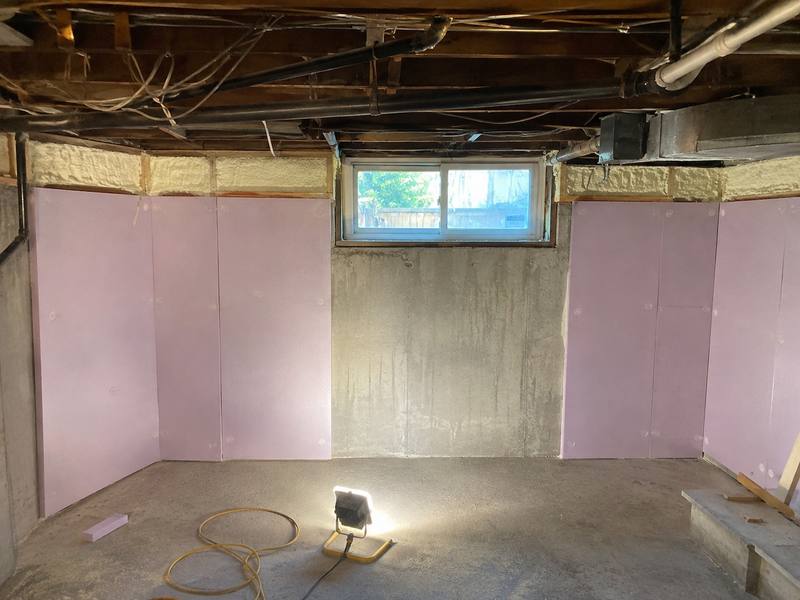
Basement insulation in North York comes down to finding where the cold gets in. In most basements, the cold air and the cold floor above it come from three places: the rim joist, the foundation walls and any crawl space under part of the house. Spray foam suits all three. We do them in that order, once any water problem has been dealt with.
Rim joists: the top edge of the basement
The rim joist is the wood band the floor joists butt into, resting right on the foundation wall. It runs around the whole house above grade, so outdoor air is right on the other side of it. Often the wood is bare, or someone has pushed a loose batt into each bay. A batt does very little to stop moving air.
Air usually gets in at the sill plate, the wooden plate fastened to the top of the foundation, and through the joint between the sill plate and the rim joist. A gap there can make the basement drafty even when the walls below are fine.
Closed-cell spray foam fixes both. Our crew sprays rim joist insulation into each bay between the joists, sealing the sill plate joint and covering the wood in one pass. Closed-cell foam also holds back vapour. That matters on a cold surface like this one: behind a batt, moist indoor air reaches the wood and can condense on it.
You can check your own rim joist with a flashlight. Find an unfinished corner of the basement, or lift a ceiling tile, and look at the top of the wall:
- Bare wood between the joists means nothing is stopping air or cold in that bay.
- Daylight at the sill plate means outdoor air has a straight path in.
- Cobwebs that move while the room is still mean a draft is coming through.
- A batt that has gone dark and dusty has been filtering air for years. It was never stopping it.
Basement walls
Basement wall insulation covers the inside of the foundation wall so the concrete or block stops pulling heat out of the room. In an unfinished basement, or one you plan to finish, spray foam on the wall gives you insulation, air sealing and a vapour retarder against the concrete in one layer.
Closed-cell foam bonds to the foundation wall and fills the small cracks and ridges that a rigid board or a batt would leave as air gaps. Those gaps matter. When warm, damp room air gets behind insulation and touches cold concrete, it turns to water, and hidden water like that is how mould starts behind a finished wall.
Foam on the inside of a basement needs a covering. Building Science Corporation's digest BSD-114 says a drywall finish over interior spray foam is required to provide fire protection to the foam. The quote spells out who puts that drywall up, so you know where our part of the job ends before anything is booked.
A damp wall needs its water problem fixed first. White powder on the concrete or a tide line low on the wall means water is coming through, and foam sprayed over a wet wall traps the moisture there. We point out what we see so you can get the source dealt with, then come back and insulate once the wall is dry.
Crawl spaces: moisture first
Crawl space insulation matters most where a crawl space sits under part of the house, like an addition or a back room. The floor above stays cold all winter because the space underneath is open to the ground and often vented to the outside too.
So the ground moisture gets handled before anything else. A bare dirt or gravel floor gives off vapour all year. The fix is a ground cover: a heavy plastic sheet laid over the soil, lapped at the seams and run up the walls. If water pools down there after rain, that drainage problem has to be fixed before any insulation goes in.
Once the space is dry, our crew sprays closed-cell foam on the crawl space walls and the rim joist above them. We insulate the walls rather than the floor overhead so any pipes or ducts running through the crawl space stay on the warm side.
The trade calls this encapsulation. Crawl space encapsulation seals the ground and the walls so the space stays dry and close to the temperature of the house. If the water side needs work before encapsulation is worth doing, we will tell you.
Cold floors upstairs
A cold floor over a crawl space or a garage usually comes from the space underneath, not the room itself. Cold air moves along the underside of the subfloor, and any gap at the rim joist lets it into the joist bays.
Our page on cold, drafty floors over a crawl space covers the signs and the fix in more detail. With a bedroom or family room over the garage, the problem is the garage ceiling, and the garage insulation page explains how we insulate it.
Rugs and a space heater cover up the symptom. Insulating underneath the floor fixes the cause.
When the basement isn't the cause
A cold upstairs bedroom, or one that bakes every July, is usually an attic problem, not a basement one. In winter, heat escapes up through a thin attic floor. In summer, the sun heats the roof deck and that heat comes back down through the same thin layer.
Foam in the basement will not cool a hot second floor, and we will tell you that on the visit. The attic insulation page explains how a top-up of blown-in fibreglass or cellulose works across an open attic floor.
Some houses need both: the basement for cold floors downstairs, the attic for the rooms at the top. We look at the whole house on the visit and tell you which to do first.
Getting the basement ready
A bit of preparation before the visit, and again before the spray day, keeps the job clean and quicker to set up:
- Clear a strip along the walls you want insulated, wide enough to stand and work in, and move boxes away from the rim joist at the top of the wall.
- Tell us where water has come in before, even once, and whether it came through a crack, a window well or across the floor.
- Mention any vermiculite or loose fill you have seen in the attic or the walls. Vermiculite looks like small grey-brown or gold pebbles. If our crew finds it, we stop at that spot and leave it alone, and we suggest you have a qualified lab or abatement firm test it before any work goes ahead.
- Plan to be out of the basement while we spray. We ventilate the area during the work, and everyone in the house stays out until the product's data sheet says it is safe to go back in.
Booking a basement or crawl space visit
Call (437) 563-1415 or go to the First Choice Insulation North York home page to have us look at your basement or crawl space. Tell us what you feel in the house and we will find the part of the building causing it.
More on Basement & Crawl Space Insulation
FAQ
Common questions about basement & crawl space insulation
Yes, closed-cell spray foam works well on basement walls that are dry. It bonds to the concrete, seals the air gaps and holds back vapour, so damp room air never reaches the cold foundation. It needs drywall over it for fire protection, and any water coming through the wall has to be fixed before the foam goes on.
A crawl space under a heated room is generally better sealed than vented, as long as water and ground moisture are under control first. Sealing means a ground cover over the soil and foam on the walls and rim joist, which keeps the space dry and close to house temperature. Open vents let in damp air in summer and cold air in winter, and the floor above suffers either way.
Yes. A finished basement can still have a bare or loosely batted rim joist hidden behind the ceiling, and it leaks air no matter how the walls are finished. The usual sign is a cold strip along the top of the walls or a draft at the edge of the ceiling. We reach it through an access panel, a dropped ceiling tile or an opening in the finish, and we agree on which before the job is booked.
Yes, once the source of the water is fixed and the wall has dried out. Foam on a wall that still lets water through holds the moisture against the concrete and the framing. We look for the signs on the visit and tell you what has to happen first.

Get a quote
Get a spray foam or insulation quote in North York
Call (437) 563-1415 or send the form. Tell us which room is cold, drafty or hot. We will come look at the spot behind it and give you a straight written quote.